Voiant Collaboration Publishes Research on Machine Learning-Based Prediction of Treatment Outcomes in Diabetic Macular Edema
WALTHAM, Mass. / PRNewswire-PRWeb
- Voiant announces the publication of a peer-reviewed study in Nature’s Eye evaluating a deep learning-based method for predicting both structural and functional outcomes in the eyes of treatment-naïve patients with Diabetic Macular Edema (DME) using baseline OCT data.
- The findings demonstrate the potential of baseline imaging biomarkers not only in treatment planning, but in clinical trial recruitment where effective patient selection can be critical to trial success.
- This research builds on Voiant’s capabilities in AI-based pre-screening and other advanced imaging analyses designed to support improved patient selection and imaging strategies for ophthalmic clinical trials.
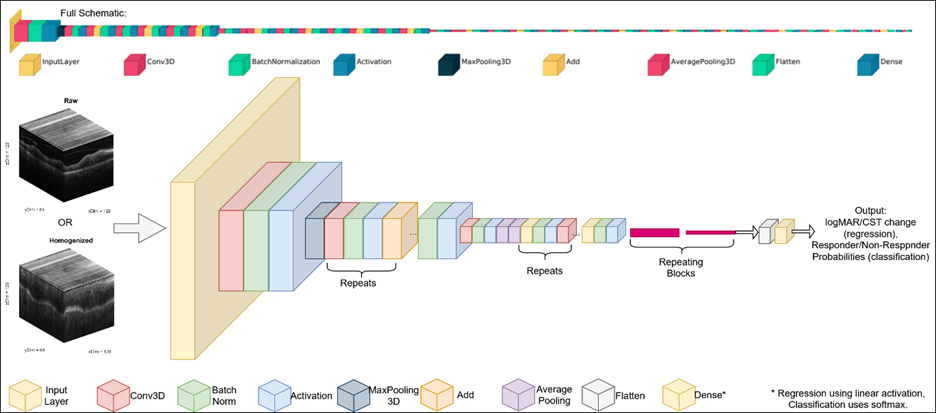
Voiant, a leader in clinical trial imaging solutions, is pleased to announce the publication of a new peer-reviewed study in Nature’s Eye. The article, titled “Deep learning–based prediction of one-year functional and structural outcomes in treatment-naïve DMO after anti-VEGF therapy” [1], presents a deep learning-based method to evaluate the prognostic information available in baseline optical coherence tomography (OCT) scans of treatment-naïve patients with Diabetic Macular Edema (DME) at the 12-month time point.
Using a proprietary preprocessing algorithm together with a state-of-the-art deep learning network, a classifier was trained to identify responders based on best-corrected visual acuity (BCVA) and central subfield thickness (CST) one-year outcomes. Defining responders as those with a BCVA improvement of at least 0.12 logMAR, and, for structural assessment, those whose one-year CST was 80% or less of the baseline, the model achieved an area under the receiver operating characteristic (AUROC) of 0.71 for BCVA and 0.97 for CST responders, respectively.
Beyond predicting response, the model was also able to accurately predict a patient’s magnitude of change in BCVA and CST. The prediction of functional/BCVA change achieved an R2 of 0.66, and the structural/CST change prediction achieved an R2 of 0.63.
The paper was first authored by Dr. Lorena Ulla of Dr. Enrico Borrelli’s research group at the University of Turin and the “City of Health and Science Hospital” in Turin, Italy, in collaboration with Voiant Senior Vice Presidents, Dr. Daniel Russakoff and Dr. Jonathan Oakley.
Dr. Enrico Borrelli commented:
“As clinicians, it is important for us to gather as much information as possible to make treatment decisions in the clinic. Our research is focused on understanding how AI can help inform this process in order to create the best plan for the patient. Our collaboration with Voiant supports our efforts to understand AI methods and how we can use them clinically. It is also clear how such technologies can be invaluable to clinical trials.”
Dr. Jonathan Oakley, Voiant Senior Vice President of Imaging & Data Sciences, stated:
“It is of critical importance that we work with expert clinicians such as Dr. Borrelli to ensure that we’re continually evolving our methods and sharing our findings within the ophthalmic community. At Voiant, we understand that by supporting clinical research, we’re helping drive effectiveness in clinical trials. We continue to advance our approach to pre-screening, and prognostic imaging methods represent an important opportunity to build on those capabilities, not only in DME, but across all indications.”
Diabetic Macular Edema (DME) is a vision-threatening complication of diabetic retinopathy and one of the leading causes of vision loss in people with diabetes. DME occurs when chronic high blood glucose damages the small blood vessels in the retina, causing them to leak fluid into the macula, the central portion of the retina responsible for sharp, detailed vision. The resulting swelling (edema) can impair visual acuity and distort central vision [2].
To speak with our team about Voiant’s AI-powered pre-screening and advanced imaging capabilities, and how Voiant can support your ophthalmic clinical trial imaging needs, visit https://www.voiantclinical.com/contact/
[1] Ulla L, Oakley JD, Fasana R, et al. Deep learning–based prediction of one-year functional and structural outcomes in treatment-naïve DMO after anti-VEGF therapy. Eye. 2026. https://doi.org/10.1038/s41433-026-04898-z
[2] American Diabetes Association. Diabetes-Related Macular Edema. Available at: https://diabetes.org/health-wellness/eye-health/diabetes-related-macular-edema
Source VOIANT
About Voiant
Voiant is the industry leading clinical trial imaging solutions provider with unparalleled scientific and clinical domain expertise — providing biopharmaceutical companies the shortest path to the highest quality imaging endpoint data. Voiant Hub is our built for purpose AI-powered platform, enabling us to manage the entire clinical imaging process while providing site management, as well as full transparency to sponsors every step of the way from image upload, quality control, read & analysis to delivering high quality clinical endpoints with unrivaled speed and precision.
Contact
+1.888.963.3742
info@voiantclinical.com